
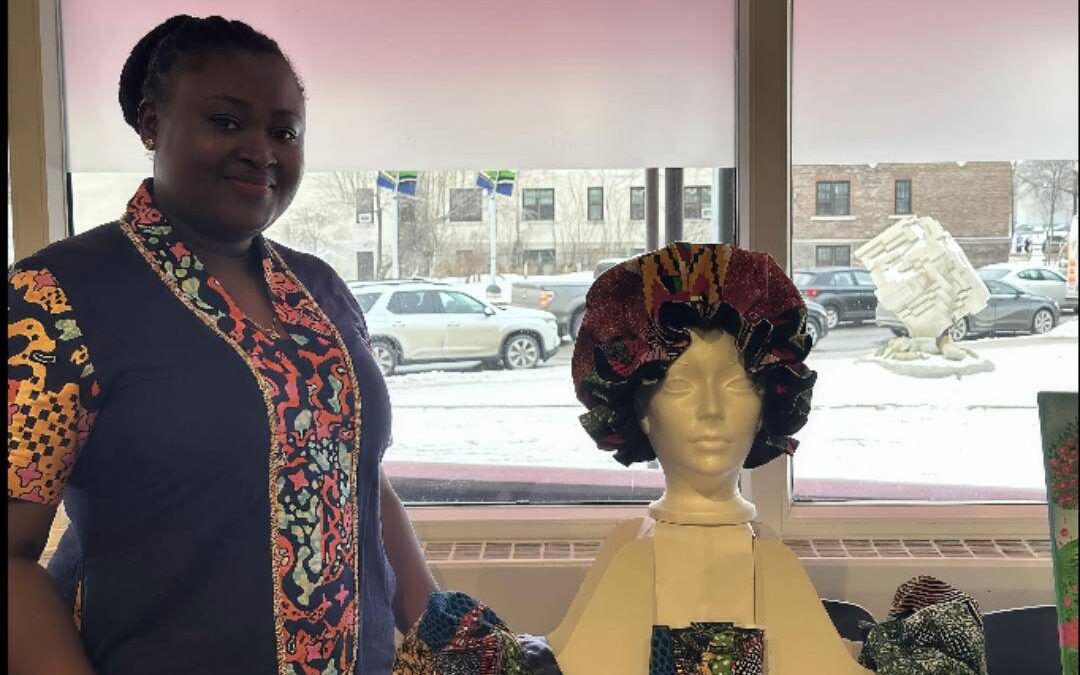
When we began making these Ankara hair bonnets, we thought we were simply creating a beautiful and functional hair accessory. However, the process revealed multiple layers of meaning. By using leftover fabric scraps from sewing projects, we prevented textile waste from entering the ecosystem and transformed materials that might have been discarded into purposeful items.
The project also became a learning opportunity. Students began to think more mindfully about waste and sustainability, repurposing old clothing into items such as book covers. This encouraged them to see how everyday materials can be reused creatively instead of being thrown away.
The significance of the work became even clearer when the bonnets were later presented as part of an EDI exhibition and art installation at the WESTCAST conference hosted by the Faculty of Education at the University of Winnipeg. As guests engaged with the piece and asked questions about the rationale behind it, conversations emerged around sustainability, creativity, culture, identity, and education. What began as a simple sewing activity was now understood as a project that carried multiple stories and connections.
Another layer that emerged was mathematics. Making the bonnet requires understanding the relationship between the diameter and circumference of a circle. When the diameter is multiplied by three, it approximates the circumference that forms the base of the bonnet, guiding how the fabric is measured and cut. Although many seamstresses say they are not good at math, sewing constantly involves measurement, pattern drafting, fractions, and spatial reasoning. In reality, they are practicing mathematics through hands on tools and materials.
The upcycled Ankara bonnets became more than a hair accessory. They represent sustainability, cultural expression, creativity, and learning, showing how even small pieces of fabric can carry meaning and connect art, identity, and knowledge.